
Your Actuaries Model Catastrophic Storms. What About the 3/4-Inch AC Drain Line Above the Ceiling?
HVAC Condensate Water Damage Prevention for Insurance Carriers

Catastrophic weather gets the headlines, but property losses don't always begin with a major event.
Sometimes the source is much smaller: a clogged HVAC condensate drain line above a finished ceiling.
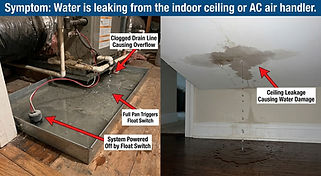
When a condensate drain backs up, the resulting overflow can damage drywall, insulation, flooring and interior finishes.
AC NeverClog™ is designed to address the problem before the backup by automatically maintaining the condensate drain line every day.
AC NeverClog™ mounts outside near the condensate drain termination and automatically runs a 60-second negative-pressure suction cycle every 24 hours.
The system pulls water, biological material and loose buildup toward the exterior drain outlet before that material can develop into a blockage. It operates without recurring chemical treatments and without forcing compressed air toward the indoor HVAC equipment.
For insurers, property managers and loss-control professionals, it provides a simple way to add preventive condensate drain maintenance between scheduled HVAC service visits.

No Chemicals. No recurring drain line treatments. No attic trips.
60 Day Money-Back Guarantee
2—Year Warranty
Residential: The Attic Time Bomb Nobody Looks At
Residential Properties: A Commonly Overlooked Source of Water Damage

Most homeowners rarely inspect their HVAC condensate drain system between service visits. As the air conditioner removes humidity from the home, condensate continuously flows through the drain line during cooling operation.
If biological buildup or debris restricts that flow, water can back up into the drain system or overflow pan. A properly installed float switch provides an important layer of protection, but it reacts to rising water—it doesn't prevent the drain line from becoming clogged in the first place.
Preventive condensate drain maintenance addresses the problem earlier by helping remove accumulating material before a backup occurs.
Rentals: When Early Warning Signs Go Unnoticed
Rental and seasonal properties present a different maintenance challenge. The person occupying the property may not recognize the early signs of a condensate drain problem, and an owner or property manager may not discover a slow leak or backup until visible damage has occurred.
Scheduled condensate drain maintenance reduces reliance on occupants recognizing those warning signs or remembering to perform recurring drain treatments.
For larger rental portfolios, automatic maintenance can also provide a more consistent approach across multiple properties.


The Condo Fight: One Pipe, Three Lawyers, and Six Flooded Units
Multifamily Properties: When One Water Loss Affects Multiple Units
In multifamily buildings, a condensate overflow originating in one unit may affect ceilings, walls, flooring or finishes in units below. That can complicate remediation, responsibility and claims handling.
Gravity does what gravity does best.
-
The unit owner questions whether the source falls under the HOA master policy or the individual unit-owner policy.
-
The HOA must determine whether the drain system is part of the unit or a common element under the association's governing documents.
-
Owners of the affected units below may have separate property-damage claims, adjusters and repair contractors involved.
-
What began with one condensate drain line can quickly involve multiple units, multiple policies and questions about responsibility.
Preventing the drain blockage in the first place can help reduce the risk of a condensate problem becoming a multi-unit water loss.
Recurring Chemical Treatments Depend on Recurring Human Action
Treatments that require someone to remember to inspect the HVAC system and repeatedly apply a product introduce a human-maintenance dependency.
AC NeverClog automates the maintenance cycle.
Float Switches and Preventive Drain Maintenance Serve Different Purposes
Evaluating Condensate Drain Maintenance as a Loss-Prevention Measure
-
Float switch: reacts to rising water.
-
Leak detector: detects water after it appears.
-
AC NeverClog: addresses buildup before a blockage.
-
HVAC inspection: verifies the overall system.
Together, they create a layered approach to condensate-related water-loss prevention.
FAST 15-MINUTE EXTERIOR RETROFIT
Exterior Retrofit With Minimal Property Disruption
Loss-prevention measures are easier to implement when installation is straightforward and disruption to the property is minimal. AC NeverClog mounts outside at the condensate drain termination, minimizing the need for access to finished interior living spaces.
AC NeverClog mounts entirely to the exterior building envelope:
-
Zero indoor disruption: Installs directly at the outdoor condensate discharge.
-
Broad compatibility: Designed for compatible ¾-inch and 1-inch PVC condensate drains, with configurations available for ⅝-inch corrugated mini-split drain lines.
-
Simple annual upkeep: Maintenance is a quick 30-second water rinse of the exterior valve assembly during normal seasonal upkeep.
Evaluating Condensate Drain Maintenance as a Loss-Prevention Measure
For insurance carriers, the important question is measurable: can proactive condensate drain maintenance help reduce the frequency or severity of water losses associated with HVAC drainage failures?
AC NeverClog™ provides a practical way to evaluate that question. The system can be deployed across compatible residential, rental and multifamily properties while operating automatically between scheduled HVAC service visits.
Potential applications include loss-control programs, risk-management initiatives and property portfolios where HVAC equipment or condensate piping is located above or near finished interior spaces.
For carriers interested in evaluating the technology, AC NeverClog can provide product specifications, installation requirements and available field-performance information for review.
HVAC Condensate Water Damage FAQs for Insurance Carriers
Can a clogged HVAC condensate drain cause property damage?
Yes. When a condensate drain becomes blocked, water can back up into the air handler or drain pan and potentially overflow. Depending on the location of the HVAC equipment, that water can damage ceilings, insulation, drywall, flooring and other interior finishes.
Does a float switch prevent condensate drain clogs?
No. A float switch is a safety device designed to respond when water rises to a certain level. It may shut down the HVAC system before an overflow occurs, but it does not remove the buildup that caused the drain line to become blocked.
How does AC NeverClog help prevent condensate drain backups?
AC NeverClog™ uses scheduled negative-pressure evacuation to help remove accumulating water, biological material and loose debris from the condensate drain line before it develops into a blockage. The factory-programmed system operates for one minute every 24 hours and draws material toward the exterior drain termination.
Does AC NeverClog replace float switches or secondary drain pans?
No. AC NeverClog™ is designed to complement—not replace—properly installed float switches, secondary drainage, drain pans, leak detection and routine HVAC inspections. It addresses drain-line buildup as one part of a broader approach to condensate-related water-loss prevention.
Can AC NeverClog be retrofitted to existing HVAC systems?
Yes, on compatible systems. AC NeverClog™ mounts outside at an accessible condensate drain termination and can be added to many existing residential and light-commercial HVAC systems. Drain configuration, pitch, trap arrangement, mounting location and electrical requirements should be verified before installation.
How can an insurance carrier evaluate AC NeverClog for a loss-prevention program?
A carrier can begin with a controlled evaluation across a defined group of compatible properties and document installation, maintenance and performance over time. AC NeverClog™ can provide product specifications, installation requirements and available field-performance information to support an insurer's review of the technology as a potential component of a broader property loss-prevention program.
